Participatory service design practice and operational infrastructure
CONTEXT
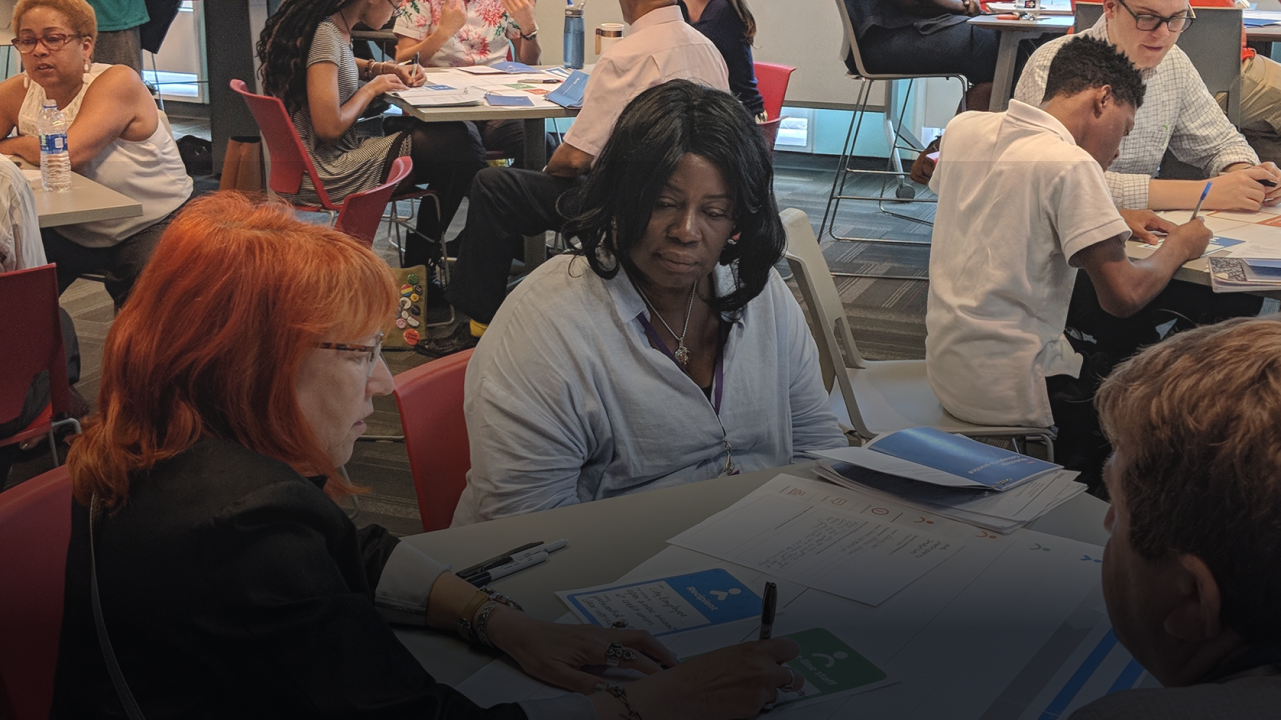
At the PHL Service Design Studio we used participatory service design to make government services more accessible, responsive and accountable. As public servants and social justice-centered practitioners, we believed equitable processes lead to equitable outcomes so we were intentional in how we work on our projects and with our partners and collaborators. Participatory approaches allowed us to co-create insights and concepts, make decisions around new improvements, and bridge relationships.
After a successful participatory service design pilot, the City of Philadelphia officially established a service design team with a dedicated mission, focus, and practice in 2020. As a founding team member, I helped formalize several foundational practices that were tested and refined across a range of projects. When the team further grew in 2024, we needed to operationalize our practice across research and evaluation, service design and delivery, and community co-design. I directed the service design and delivery practice in collaboration with other practice directors and the executive director.
-
2023–2026 (Team member since 2017)
-
Project co-lead: Devika Menon, Director of Service design & delivery
Project co-leads: Andrea Ngan, Community co-design Director and Beth Cain, Research & Evaluation director (until 2024)
Executive Director: Liana Dragoman and Danita Reese
Support: Ciara Ali Khan, Lead service designer, Veronica Yeung (until 2023)
APPROACH
The service design practice was iteratively built on lessons over eight years of practice through ongoing project reflections, testing across projects, and co-creation with team members.
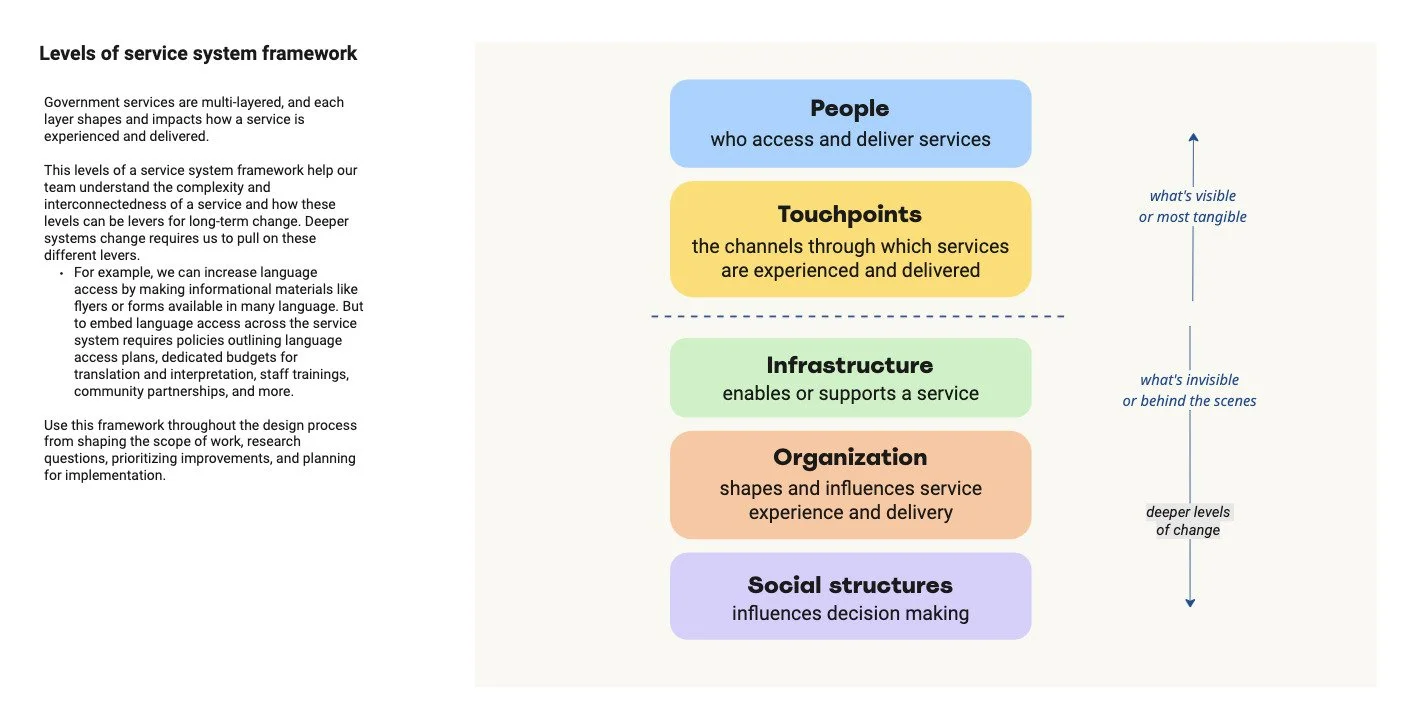
To ground our work, I co-developed a holistic framework for the interconnected components of a service, both the visible and invisiblem, that we can influence and design for. Government services are complex and multi-layered, each aspect of a service shapes and impacts how a service is experienced and delivered. The framework helped our team understand that complexity and see each component as a levers for immediate and long-term change.
OUTCOMES
Roles and skills: Defined new service design and delivery roles and essential skills required. These became a part of the team's career ladder, 360 performance reviews, and hiring protocols for six new team members.
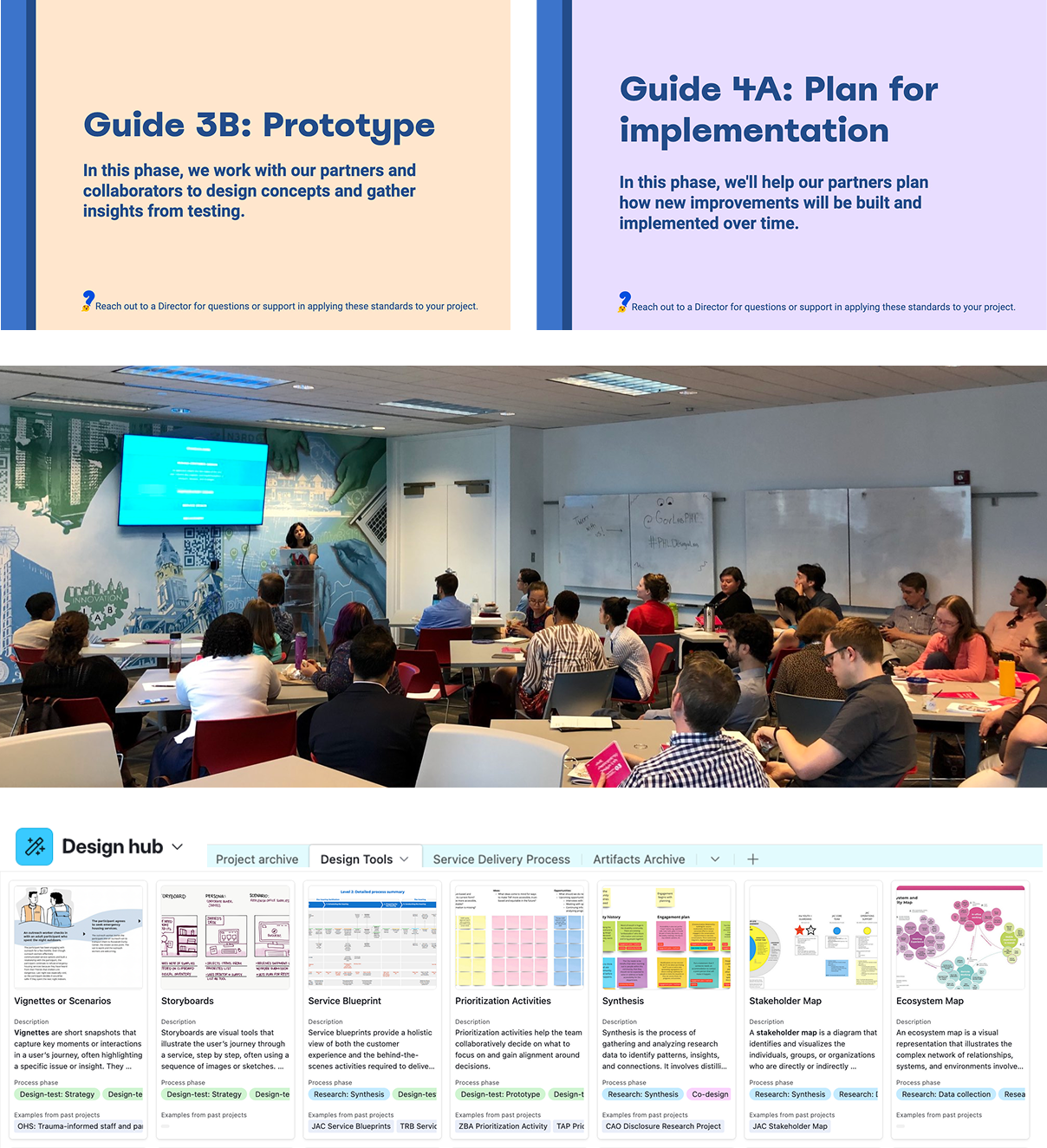
Guides and tools: Co-created, refined, and stewarded the team's participatory service design process and phases of work. For several phases of the process, I developed practice guides that outlined standards of practice, sample deliverables, tools, and guidance for team members to apply and adapt across projects. The practice guides were paired with templates like a research protocol, consent forms, research summaries,service assessment framework, implementation plan, and inclusive facilitation methods.
Mentorship: Coached team members in applying participatory service design practice to ongoing projects through hands-on coaching, structured feedback and review, project reflections, and thought partnership. Wrote expectation-setting documents that clarified project roles, standard and non-negotiable practice, and constraints.
Operations: Co-created and co-led the Studio's mission, values, organizational strategy, and operational infrastructure with other practice directors and executive director. Structured team-wide feedback meetings and project reflections to regularly reflect and iterate on practice. Initiated the creation of a teamwide "design hub" resource database and supported a team member, Ciara Ali Khan, who iteratively built it out.
Programmatic consulting: Led the development of a pilot consulting model for our team to support city colleagues in using participatory service design approaches in their work. Created expectation-setting documents and templates for team members on how to lead consulting projects.
IMPACT
When scaling the team, the practice guides, templates and various expectation-setting documents became help to orient and onboard new members and apply standard practices to their projects. Our new consulting model was successfully piloted with the Office of the Youth Ombudsperson, Immigrant Affairs, Re-entry office, Innovation and Technology— increasing the number of projects and city colleagues our team could support in addition to ongoing full-scale projects.
Our foundational service design practices were also used for broader education and advocacy to build understanding and capacity for design inside City government. I designed and facilitated Citywide learning sessions, workshops, and presentations with staff at all levels of government on service design, participatory methods, equitable community engagement practices. I also provided office hours for colleagues to consult on applying service design to their own work.