Trauma-informed homeless service transformation
CONTEXT
When Philadelphians face homelessness, they turn to the City of Philadelphia’s Office of Homeless Services (OHS) to access prevention and shelter services. They arrive at intake sites at their most vulnerable. They might be fleeing domestic violence, sleeping on the street, or newly displaced. It’s at this time they must navigate spaces, paperwork, and processes that can feel cold, confusing, and opaque. Some feel unwelcome or even abandon their efforts. Staff who support them take in difficult stories daily and work in highly resource-constrained conditions with limited support which can lead to vicarious trauma, burnout, and disempowerment.
Considering these realities, OHS wanted to reimagine how their services could be more trauma-informed in practice for both people experiencing homelessness and the staff who support them through a more person-centered approach.
This project was part of the PHL Participatory Design Lab, an initiative funded by the Knight Foundation, to improve City services, programs, and policy using evidence-based methods.
-
2017–2019
-
Office of Homeless Services, City of Philadelphia
Bruce K. Johnson, Tara Gaudin, and Liz Hersh
-
Project lead & oversight: Liana Dragoman
Service Designer & workstream lead: Devika Menon
Implementation partners: Arin Black, Clare Cutugno, Tamar Fox, Ballinger, Office of Information & Technology, Office of Immigrant Affairs, and OHS intake administrators and managers
Trauma expert: Dr. Megan Corrado
APPROACH
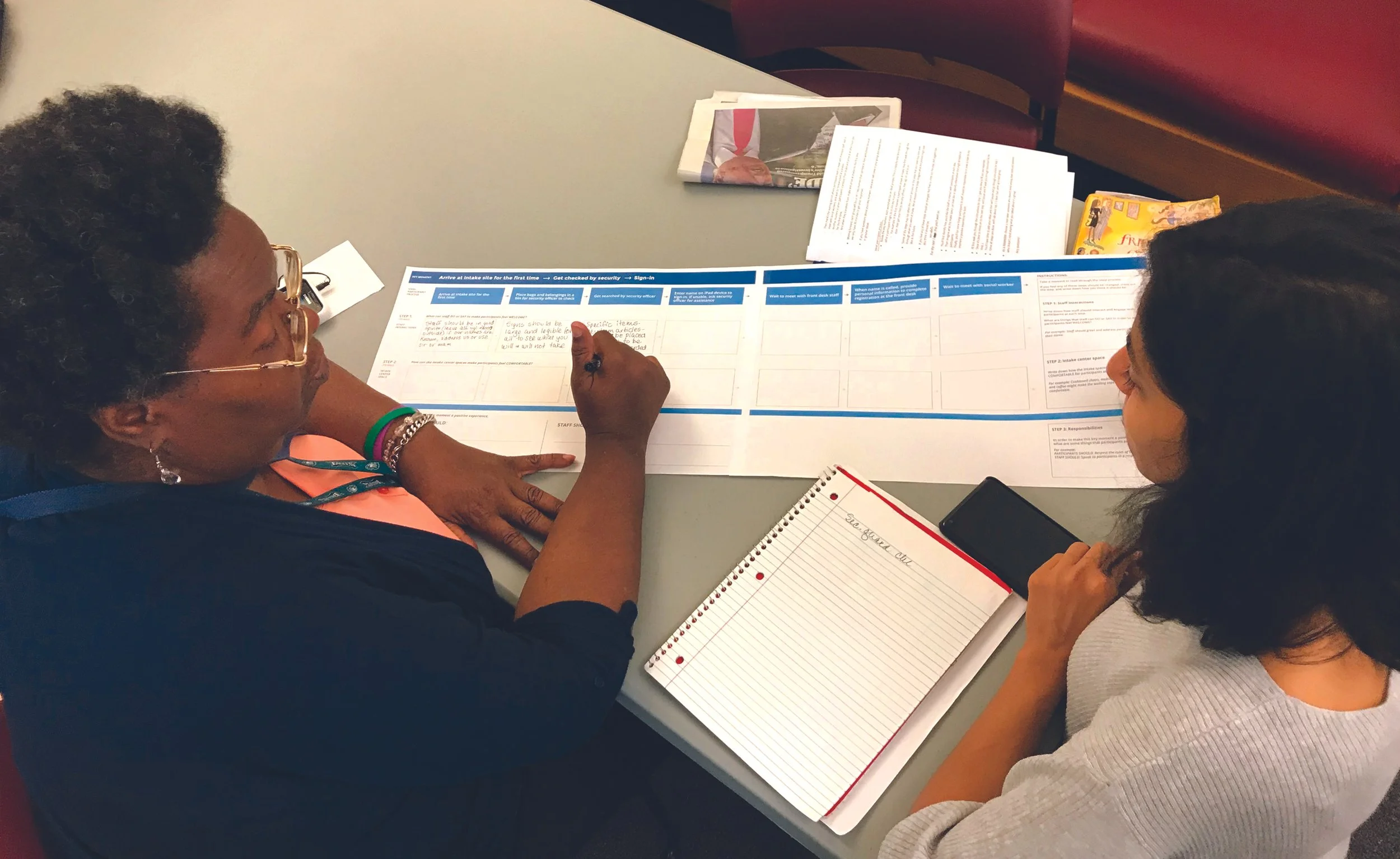
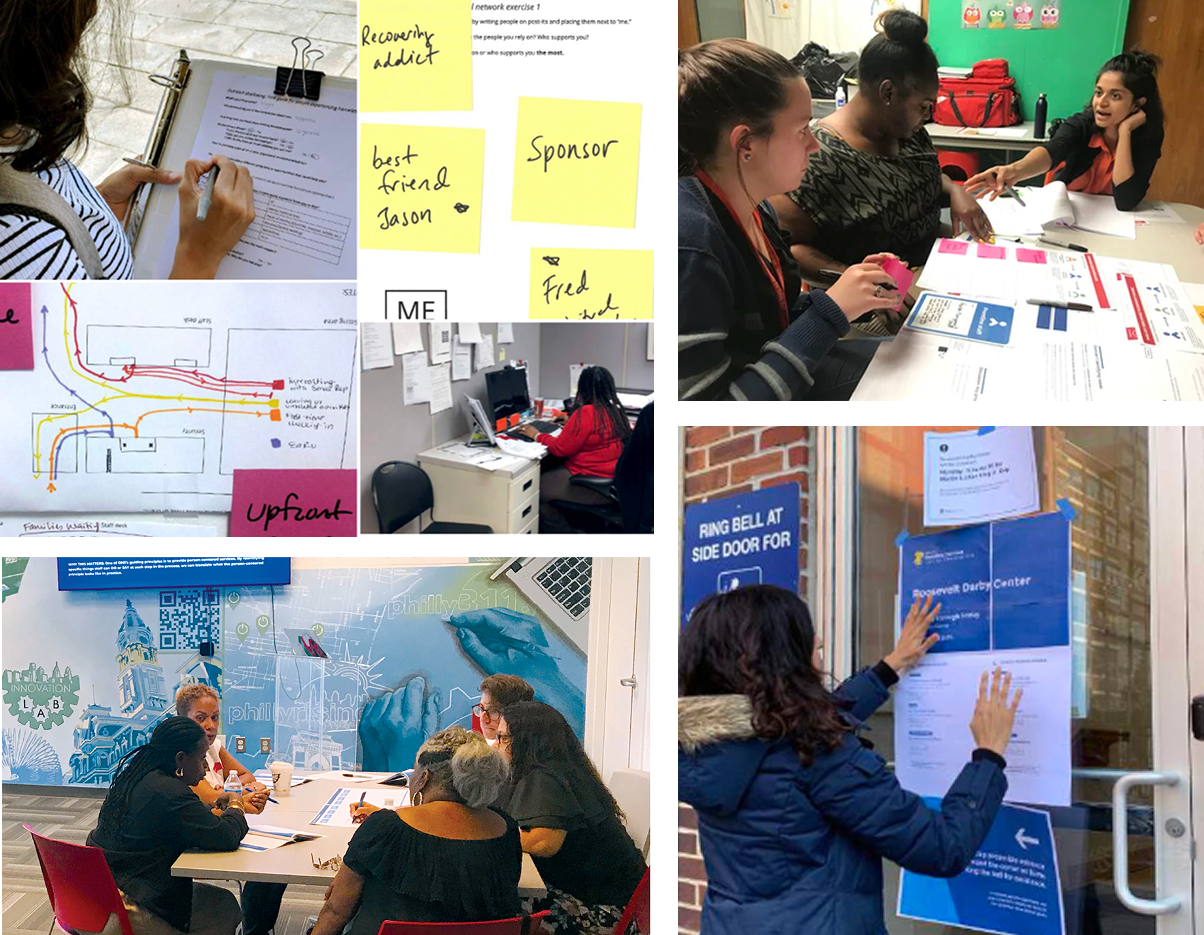
Through a participatory design process, we collaborated with over 220 stakeholders, including unhoused Philadelphians seeking services and those refusing services, City and nonprofit partner staff, outreach workers, community advocates, social work staff, customer service representatives, trauma experts, civic design professionals, and organizational leaders and policy makers.
Research: Built deep understanding through listening sessions, site observation sessions, shadowing on the job, literature review, and 1:1 interviews.
Insights and opportunities: Shared back and co-created insights and improvement opportunities through sense-making sessions.
Design: Co-created a new trauma-informed service vision, process, and tools through collaborative design workshops. Prototyped and tested new improvements at intake sites before implementation.
Implementation: Implemented improvements across intake centers through collaborative decision-making sessions with staff, usability testing, training, documentation.
OUTCOMES
We identified implementation projects that would have an impact on the service immediately and in the long term. For each project, we put together teams and partners whose expertise spanned service design, content strategy, trauma-informed care, and deep subject-matter in homeless services.
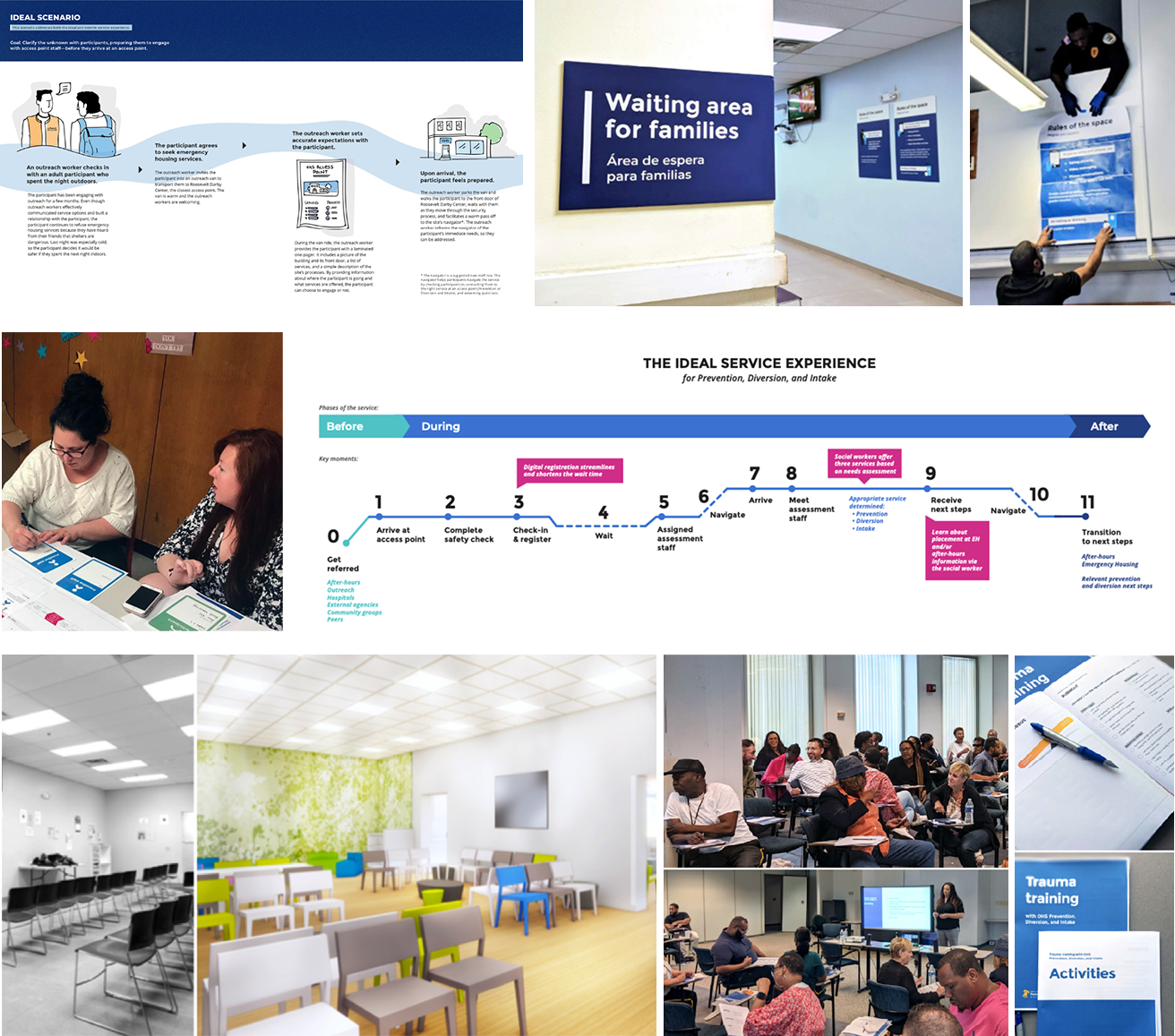
Project 1: Developed a holistic strategy for a trauma-informed service experience based on a vision co-designed with key stakeholders. The strategy guided the design and decisions around all new improvement projects. Documented and published the project across two comprehensive public reports and a series of blogs.
Project 2: Reimagining service interactions between participants and staff to be more trauma-informed in practice. Co-created future-state service maps, trauma-informed interaction scenarios, and materials for staff training and roll-out.
Project 3: Designed and implemented a range of informational interventions to clarify the service experience in partnership with content strategists and writers. Content strategists audited over 130 pieces of information and from there we released 8 informational one-pagers to set expectations, 3 redesigned forms, a website page, phone message scripts, and over 100 wayfinding signs.
Project 4: Designed a trauma-informed space plan and strategy for how physical service environments can support participants and staff in moments of crisis. Using that strategy, a local architecture firm, Ballinger, developed comprehensive renderings, layouts, material selections, and renovation requirements.
IMPACT
Shared decision making: Participatory methods helped deepen relationships within the hierarchy of government and with external partners and redistribute decision-making power. We worked closely with those closest to service challenges—service participants and frontline staff—who are often excluded from informing decisions that directly impact them. During the process of designing together, people felt heard and saw their contributions and decisions reflected in project output. Through implementation, intake site administrators and supervisors became part of our project team driving decisions on how new improvements would be implemented across the intake sites.
Pilot success: As the City’s first participatory service design pilot, this work demonstrated the value of participatory service design in government and led to the creation of the PHL Service Design Studio in 2020, which was of the early municipal government service design teams in the US.
Recognition: The project was also recognized and shared with the global Service Design Network, Code for America, Baltimore city, Drexel, Penn, and other groups interested in applying trauma-informed service design to their own work.