Employee workplace protections and complaints processes
Year: 2023 / Role: Project lead, Senior Service Design Strategist / PHL Service Design Studio
CONTEXT
When the City of Philadelphia’s employees experience issues like discrimination, harassment, or misconduct in the workplace, they can report their concerns to supervisors, HR managers, senior leaders, or City agencies who are tasked with addressing employee issues. Employees often experience barriers like limited awareness on reporting pathways, fear of retaliation, or uncertainty if reporting will lead to meaningful change.
Six City agencies handle different aspects of workplace protections from receiving and triaging instances of discrimination, harassment, or misconduct to investigating, addressing, and reporting on issues. Inconsistent practices, communication channels, and infrastructure limit how these offices collaborate and handle issues within their distinct mandates and purview. This can create gaps where employee complaints can fall through or become hard to track.
The PHL Service Design Studio team partnered with the six agencies to improve how the City of Philadelphia addressed employee workplace issues and provided a safe and inclusive workplace. The agencies included:
Office of the Inspector General
Office of Diversity, Equity & Inclusion
Labor Department, Employee Relations Unit
Office of the Chief Administrative Officer
Office of Human Resources
Office of the Employee Ombudsperson
This project was conducted at a time the City was preparing for a new incoming administration and so it was intentionally structured to deliver short-term actions and future-oriented goals.
CONTRIBUTIONS
Understanding experiences on sensitive & legal topics
Led mixed-methods research to understand how employee complaints were reported, handled, and addressed across the City. Engaged departmental HR staff, supervisors, department heads, integrity officers, and employees through 17 interviews, focus groups with 47 employees, and anonymous survey with over 1,300 employee responses. Balancing the role of a researcher and a City employee came with constraints and nuances which led to conducting literature reviews to fill gaps in our research.
Translating insights into strategic opportunities
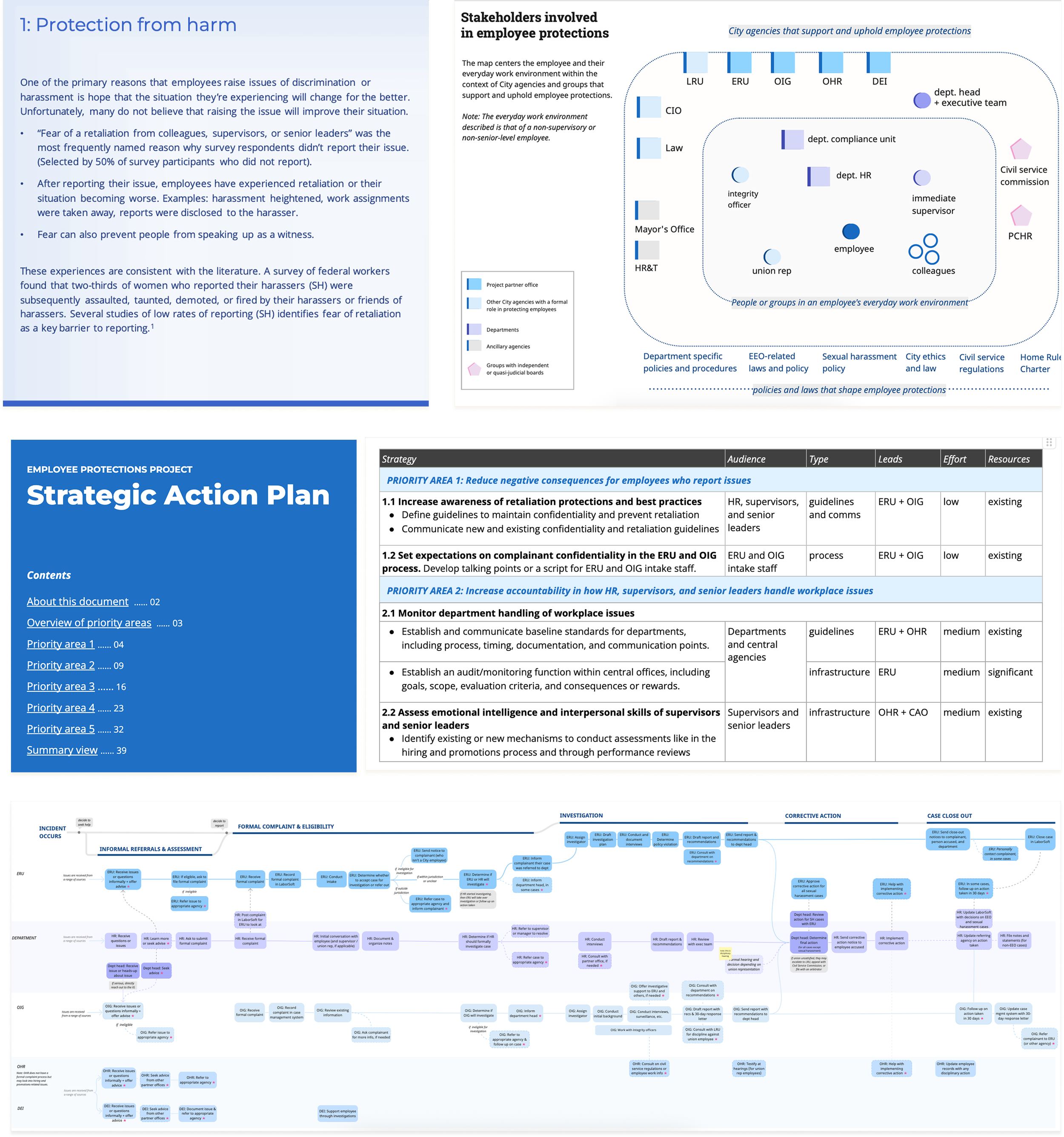
Led the synthesis and prioritization into a strategic action plan outlining several short and long term improvement recommendations, resource needs, agencies responsible, and implementation requirements. Supported the development of assessment and triage tools for supervisors and HR managers and an employee-facing communications plan.
Building shared understanding and collaboration mechanisms
Brought six City agencies together in an ongoing collaborative process to identify challenges, clarify responsibilities, articulate a shared vision for employee experiences, and draft shared agreements on referral pathways and communication responsibilities to ensure complaints don't fall through. Documented existing processes, agency roles, and journeys of complaints to build a shared understanding among the six agencies and support future decision-making on handling issues.
SIGNIFICANCE
The project helped build shared understanding across a complex institutional and legal landscape highlighting the current state of employee experiences and a future vision for a more inclusive and safe workplace.
Strengthened cross-agency collaboration through clarified and agreed-upon roles, responsibilities, department-specific processes, and shared collaboration agreements.
The research insights and strategic action plan gave the agencies a shared set of priorities and recommendations that each office could propose to the new incoming administration.
The newly appointed Employee Ombudsperson used research findings to orient to the landscape and shape the office’s services to employees.
Beyond the project, the Ombudsperson continued to organize the six partner agencies through monthly convenings to discuss and move through the recommendations.
Team and credits: Project lead: Devika Menon, Project support and workstream lead: Veronica Yeung, Project oversight: Liana Dragoman